urban sketching: how to color
Fact 1: Most sketches look better in color. It’s not a hard rule; sometimes a black-and-white composition has extra pop. But in general, color is good.
Fact 2: I’m often reluctant to color my urban sketches.
- If I like my sketch, I’m worried about messing it up.
- I do not color on location. I generally travel light with just my Strathmore & micron. So I may not remember the colors by the time I get home.
- Some of my sketches have incomplete or only partially rendered areas and I’m not sure how to color them.
All of these are surmountable. The biggest issue is the first. WHAT IF I ruin my sketch OH NO. This is why Sarah Cray says you often learn more from “bad” paintings: you don’t feel precious towards them, which frees you to experiment and play and learn.
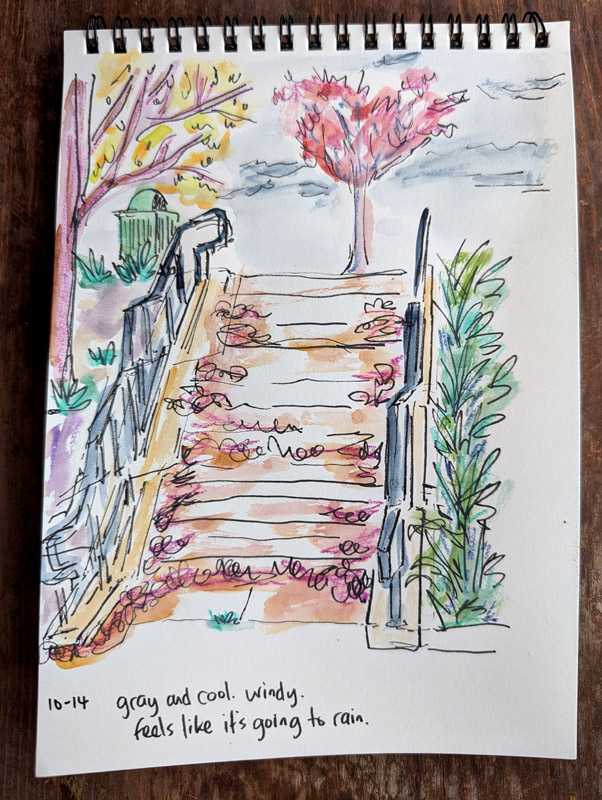
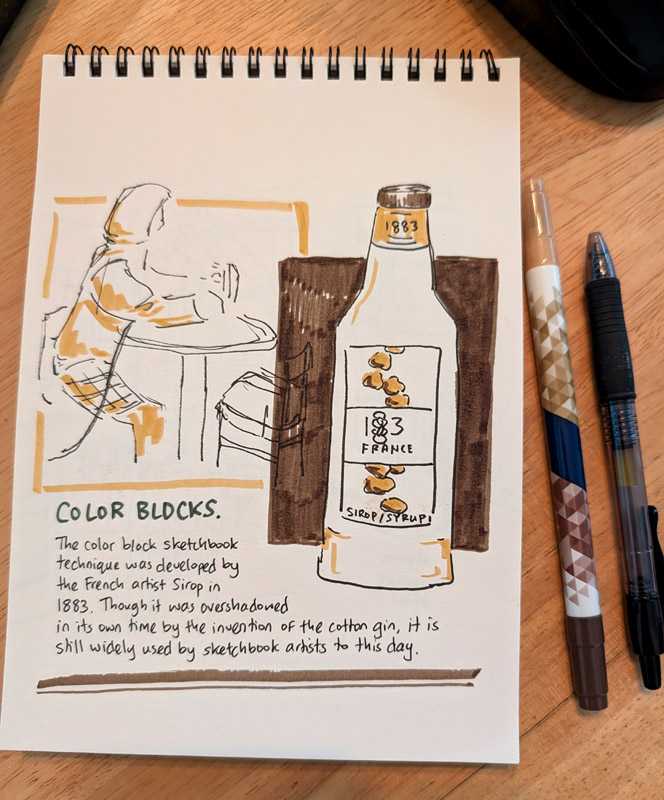
I decided to leverage this idea. Every sketch I don’t like gets chucked into the Color Experimentation Zone. The stairway with the mangled nonsense railing. The scuffed unfinished sketch of the guy at Starbucks and a random syrup bottle. I colored them and suddenly the pages looked okay. This is like actual sorcery irl.
These successes have emboldened me to try coloring sketches I like. However, this brings me to issue #2: sitting down at home and thinking “okay, what color was this?” Fortunately, I’m not set on color fidelity or strict realism. But I do feel a tad lost looking at a sketch and thinking of how to color it. Also, shadows are so intimidating and I have no clue how they work.
Liz Steel does her coloring on location. She carries a sketching bag with a watercolor palette and a brush, a couple water jars, pens, markers, watercolor pencils, and separate snapwares for neocolors I and II. For a while she was also lugging around a massive hardcover 11 x 14 sketchbook, though she’s scaled back to an A4. I respect it. But it’s not for me. I could get a pencil case for a few neocolors and watercolor pencils if I’m planning, say, a long sit-down sketch session at a cafe. I’d still rather keep the watercolors at home.
The third issue, how to color partially rendered sketches, is deceptively simple. You partially render the coloring too. Done and done. tbh I suspect there’s a learning curve of how to make this look good. But Liz makes it look great. She often combines it with limited palette, e.g., a cafe interior where the seat backs (the most distinctive element) are blue, and other elements are blue or yellow ochre, and less important areas remain uncolored.
Above all, a sketchbook is a place for experimentation and play, and not every page will be good and that’s fine. All the experts agree on this. But what do you do when a page turns out bad? Here there is sharp divergence and it’s so funny to me. Sarah will paint over the whole thing in gouache and make an entirely new painting. NO UGGOS IN MAIN. Fucking ruthless. Liz/Danny would never. They value the journal aspect of art; to them, even if a page isn’t good, it’s still the real lived experience of that day and should be preserved. That’s my own style too.
Photos
Comments
Times shown in UTC
No comments yet.
You must be signed in to post a comment.